
I can't tell you what retatrutide does. I haven't written an article for glp3.wiki in two months. It just crossed 111,000 impressions on Google.
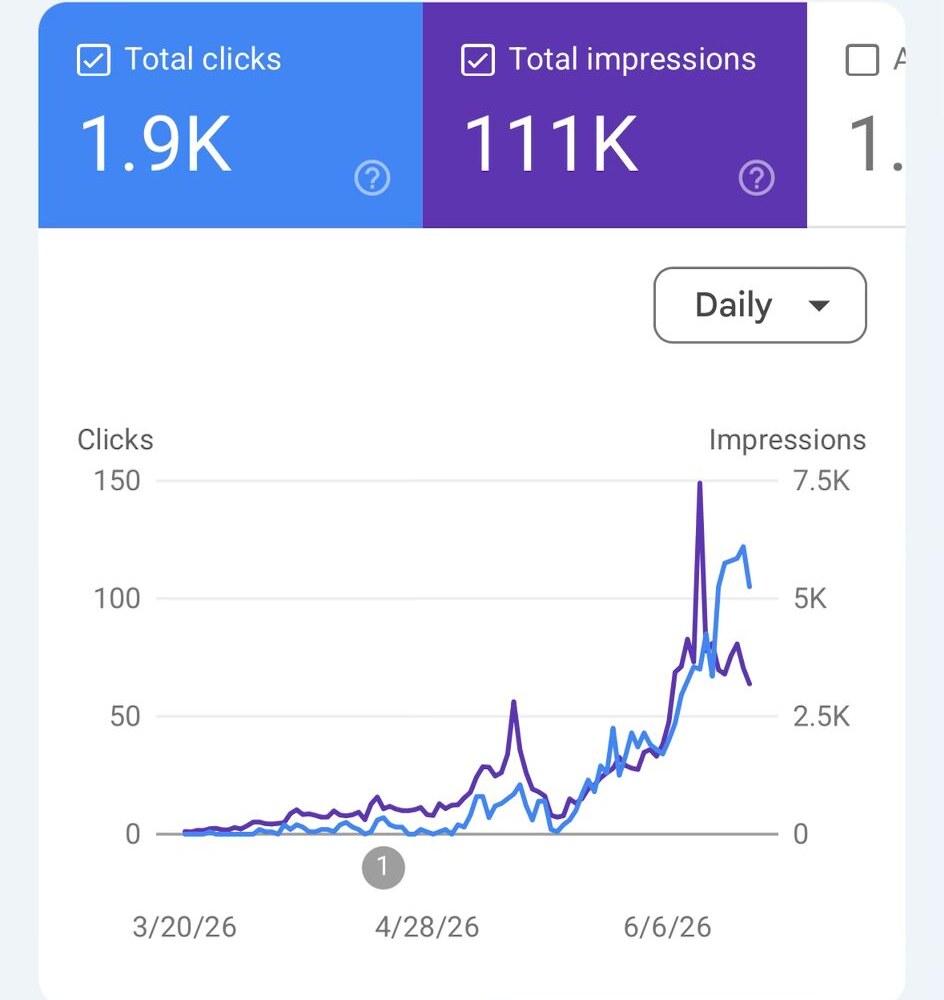
A stranger on X asked me what I didn't expect to work that actually did. I told him: I picked a niche I knew nothing about, to learn programmatic SEO, and let Claude run it. He asked the obvious follow-up: what does “letting Claude run it” actually look like?
Here's the whole setup, the tools, and the loop prompt at the end, so you can point it at your own niche.
I wasn't trying to build a peptide wiki. I saw Andrew Huberman call retatrutide a “trillion-dollar drug” about to change everything, watched the replies go feral, and thought: clearly there's demand here, and I understand none of it. Perfect.
Perfect, because the topic didn't matter. The cleanest way to test a method is to take yourself out of it. If I'd picked something I knew, like Claude Code, I'd have leaned on what I already knew and never found out whether the system worked. Knowing nothing forced the agent to do the research and the writing itself. None of what follows needed me to know what a GLP receptor is.
The loop has since written the site's own explainer on what Huberman actually said. The thing that seeded the niche became one of its pages, and I had nothing to do with it.
One loop, fired daily by a scheduled job, doing six things.
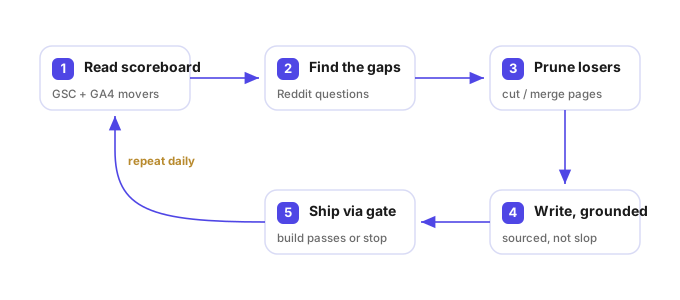
What's missing from that list is me, picking topics. The agent picks them, from the data and from what real people are asking. I glance at the digest once a day and occasionally say “go deeper on X.”
People ask about the three marketing skills, but those are tools, not the engine. The engine is an orchestrator skill, glp3-daily, that runs the whole loop and holds the judgment: what to write, what to leave alone, what to roll back. Everything else is something it calls.
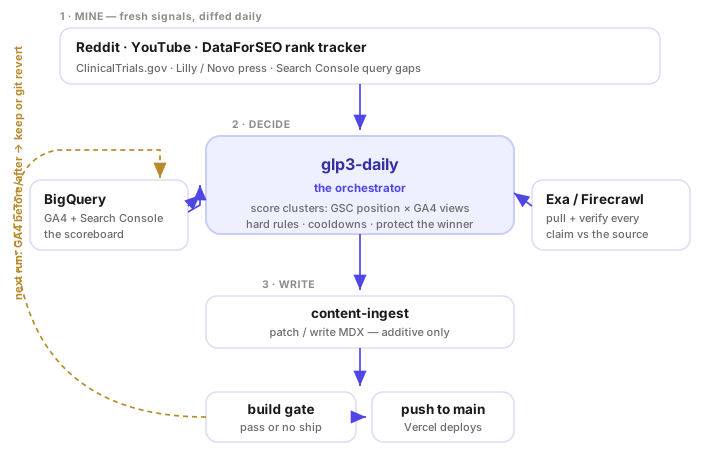
Walking the diagram:
content-ingest, turns the chosen source and keyword into MDX, additive only, never rewriting prose that already works.The hard rules are what make it safe to leave alone. Additive edits only on main. At most three changes a run, and at most one new article. A seven-day cooldown per page (fourteen for the breadwinner). And a self-rollback: if a page that had real traffic drops more than 30% after an edit, the next run reverts the commit.
Exa is a search API built for machines rather than people: you hand it a query or a claim and it returns the most relevant pages with their full text, so an agent can read and cite the actual source instead of trusting its own memory. For a medical site that is the whole ballgame — nothing ships from the model's recollection.
The loop calls it twice. Once to pull the source it's writing from, and again to verify every load-bearing number — a weight-loss percentage, a trial result, an FDA date — against a primary source before publishing. Anything it can't verify gets cut or flagged, never guessed. For paywalled journals that block a plain fetch (NEJM, The Lancet), it falls back to Firecrawl, which renders the page like a real browser.
# pull the source you're writing from
exa scrape "<url>" --max-chars 10000

# verify a specific claim against primary sources before it ships
exa search "retatrutide TRIUMPH weight loss percentage" --text -n 5This is the step that makes autonomy possible, and almost no one takes it. Both Search Console and GA4 pipe into BigQuery in a few clicks: Search Console → Settings → Bulk data export; GA4 → Admin → BigQuery links. Then Claude queries your real traffic in whatever shape the question needs: URL by query by week, impressions joined to on-page behaviour, anything.
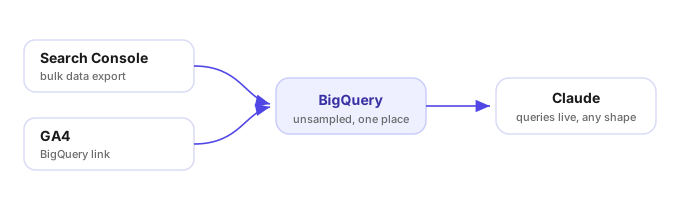
There's a Search Console MCP too, and it's a great on-ramp: OAuth, a fixed set of tools, working in minutes. But it serves sampled data through a fixed set of questions. BigQuery gives the agent every row, unsampled, and lets it write arbitrary SQL across Search Console and GA4 at once. Start with the MCP. Move to BigQuery when you want the agent to slice the data in ways a fixed tool can't.
A few things carry over to any topic.
git reverts the commit. (GA4 is the primary signal because most pages get more traffic from ChatGPT citing them than from Google; Search Console is a cross-check for the few pages that rank. The build is just a safety gate, not how it knows the writing landed.)glp3.wiki is the proven one. The same setup now points at untrappable.com and drafty.im. The checklist is the same: wire the data into BigQuery, point the three skills at the new niche, set the daily loop, and wait. Neither has results yet, so treat this as one proof and two open bets.
An autonomous loop nobody looks at will quietly drift. Changes ship while you sleep, and you find out something broke when the traffic does. So I keep a daily check on it.
Every run, it posts its digest to a Drafty canvas: what it changed, what's ranking, what it killed. I open it on my phone, point at a line, and leave a comment. Next run, the agent reads the comment and acts on it. That's the entire human-in-the-loop: a daily glance and the occasional nudge.
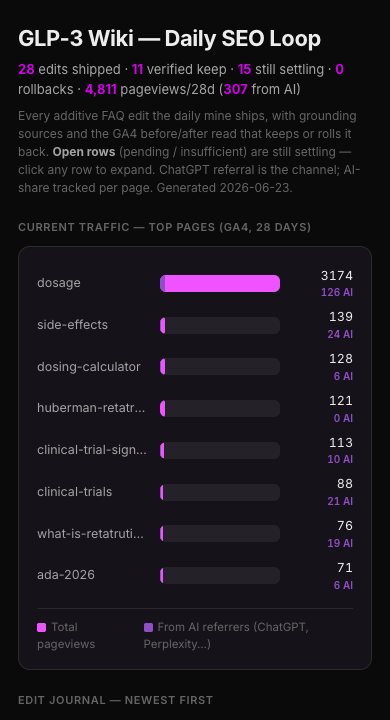
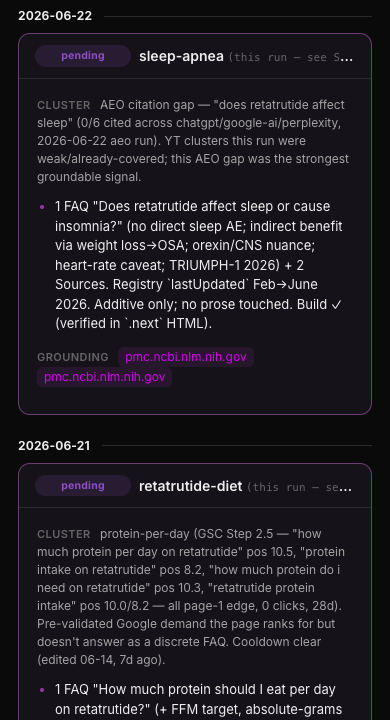
If you build one of these, build the daily check too. The autonomy is only safe because I can still see what it's doing.
This is the shape of the orchestrator, close to the real glp3-daily skill. Wire it to the mining skills, Exa, and a BigQuery-connected project, schedule it daily, and you have what runs glp3.wiki.
# daily SEO loop — runs unattended, once a day

0. Verify yesterday. Read the journal. For each past edit now due for
   review, compare the page's GA4 pageviews (7 days before vs after). If a
   page that had real traffic dropped >30%, git revert that commit.

0.5 Canary. Check the breadwinner page's Search Console rank
    week-over-week. A drop of 3+ positions: stop and alert a human.

1. Mine. Pull only what changed since yesterday: new Reddit and YouTube
   questions, rank-tracker movers, new trials and press, and the Search
   Console queries where the site shows up but doesn't rank.

2. Cluster + dedupe. Group the questions. Drop anything already answered
   (check the covered-questions ledger).

3. Score + pick. Rank opportunities by Search Console position x GA4
   pageviews, favouring page-2 pages one edit from page 1. Obey the rules:
   additive only, ~3 edits max, never touch a page inside its cooldown
   (14 days for the breadwinner), never rewrite prose that works.

4. Ground + write. For the top pick, verify every claim against a primary
   source with Exa (Firecrawl for paywalled journals). Patch the article
   or draft a new one. Cut anything you can't verify.

5. Gate + ship. Run the production build. If it passes, push to main.
   If it fails, don't ship.

6. Journal. Record what changed and when to verify it, so tomorrow's run
   can check whether it worked, and a digest goes to the Drafty canvas.
I picked a topic I knew nothing about, wrote three small skills, connected the data, and got out of the way. The impressions are real, and none of them needed me. Yours won't need you either.
Building many pages that each target a specific search, rather than writing a few big articles by hand. You publish broadly, but the traffic rarely spreads evenly. On glp3.wiki the dosage guide alone is about 38% of impressions, so the real work is spotting the breakout page and concentrating on it.
Within guardrails, yes. The guardrails are what matter: source-grounded research, a check on each change's Search Console numbers that keeps or rolls it back, and a daily digest a human actually reads. Without them you get slop. With them, the output holds up.
Google penalises unhelpful content, AI or not. The loop's defence is built in: pages that don't earn impressions get removed instead of defended, so only what performs stays up.
MCP to start, since it runs in minutes. BigQuery once you want unsampled data and arbitrary queries across Search Console and GA4. For an unattended loop, BigQuery is worth the setup, because the agent needs to slice the data in shapes a fixed tool can't.
It runs on a single Claude subscription plus BigQuery's free tier at this volume. The work is scoped and daily, not open-ended exploration, which is what keeps it cheap. The same pattern runs my morning analytics digests across subs.rip, journeys.im, and bq-analytics.
Yes. Install the mining skills, wire your data into BigQuery, give Exa an API key for grounding, adapt the orchestrator prompt above, and post the digest somewhere you'll actually look. Start with one niche you can verify, and let the scoreboard tell you what to keep.